A gem is worth what a buyer believes it is. Belief needs proof. That proof comes from gemology. It is the science that tells a real stone from a fake one. It also tells a fine stone from a flawed one. The work happens in quiet labs, under bright light, with tools small enough to travel in a case.
Gemology is the science of natural and artificial gemstone materials. It is a branch of mineralogy. Jewelers trained as gemologists can identify and value gems, as Wikipedia notes. Their methods are patient and hands-on. They follow a clear order, from first glance to final grade.
Grading Starts With Elimination
Naming a stone is a process of elimination. Rough stones get a close look first. The gemologist studies the outer surface, the host rock, and the natural color. Stones of like color then take a series of light tests. The tests do no harm. They run until one identity is left. No single test gives a sure answer, so a gemologist never leans on one result. The basic checks cover color, refractive index, optical character, specific gravity, and the inner features seen under magnification.
Measuring How Light Behaves
Light tells the truth about a stone. Every material has a critical angle. Above it, light bounces back inside the gem. A refractometer measures that angle, and the reading pins down the identity. Contact liquids for this test reach up to 1.81, according to Wikipedia. Weight gives a second check. The gem is weighed in air, then in water. The two numbers give its specific gravity. The figures split look-alikes. Per the same source, ruby sits at 4.00, glass runs from 3.15 to 4.20, and cubic zirconia lands at 5.6 to 5.9. So cubic zirconia stands apart at once. Ruby and glass overlap.
Inside the Stone: Inclusions and the Loupe
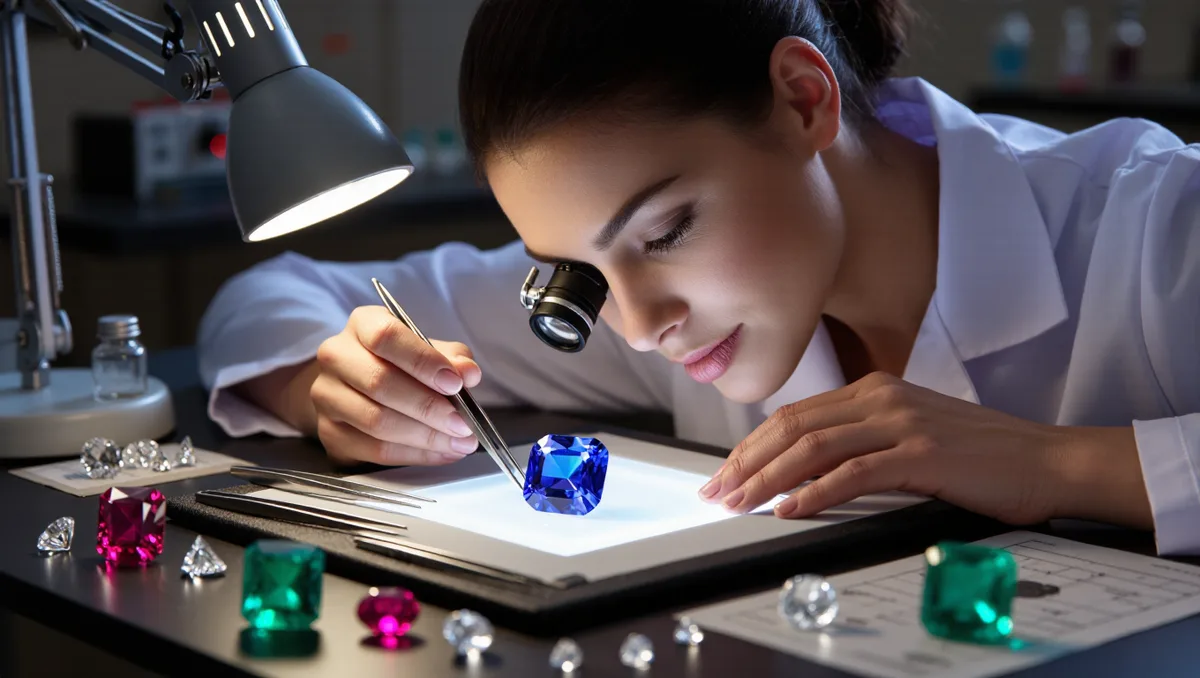
Clarity work means looking within. Gemologists study the inside of a stone under magnification. A gemological microscope is the main tool. Natural stones carry fluid inclusions. These are marks left by the geology that made them. Synthetic stones lack these natural clues. Heat used to boost color leaves partially melted crystals, and those give it away. This close study decides if a gem is natural or synthetic. No two gems are the same. Small chemical quirks make each stone an individual. For related coverage, see What Sustainability Means in Luxury Jewelry Sourcing.
Why Origin Moves the Price
Where a stone grew matters. Spectroscopy reads the atomic structure of a cut gem. It can point to the place the stone came from. That is a major factor in value. A ruby from Myanmar, for example, shows clear internal and optical differences from a Thai ruby. Two red stones may look the same on a tray. The market still treats them as different goods.
The People and Labs Behind the Grades
Formal gem training is young. Rudimentary teaching for jewellers began in the nineteenth century. The first gem lab serving the jewelry trade opened in London in 1925. Cultured pearls and new synthetic rubies and sapphires drove the change. Robert Shipley was the first US graduate of the Gem-A diploma course, in 1929. He went on to set up both the Gemological Institute of America and the American Gem Society. Travel labs now pack a full set of tools into one case. That lets testing happen on site, far from any city.
Conclusion: Proof Under Magnification
Gem grading is not a glance and a guess. It is a chain of tests. The refractometer reads the light. The microscope reads the inside. The scale reads the weight. Each step cuts the options until one identity is left. That is how a soft opinion becomes a grade a buyer can trust. We covered a connected angle in Luxury SUV Buyer's Guide: Size, Comfort and Price Tiers.