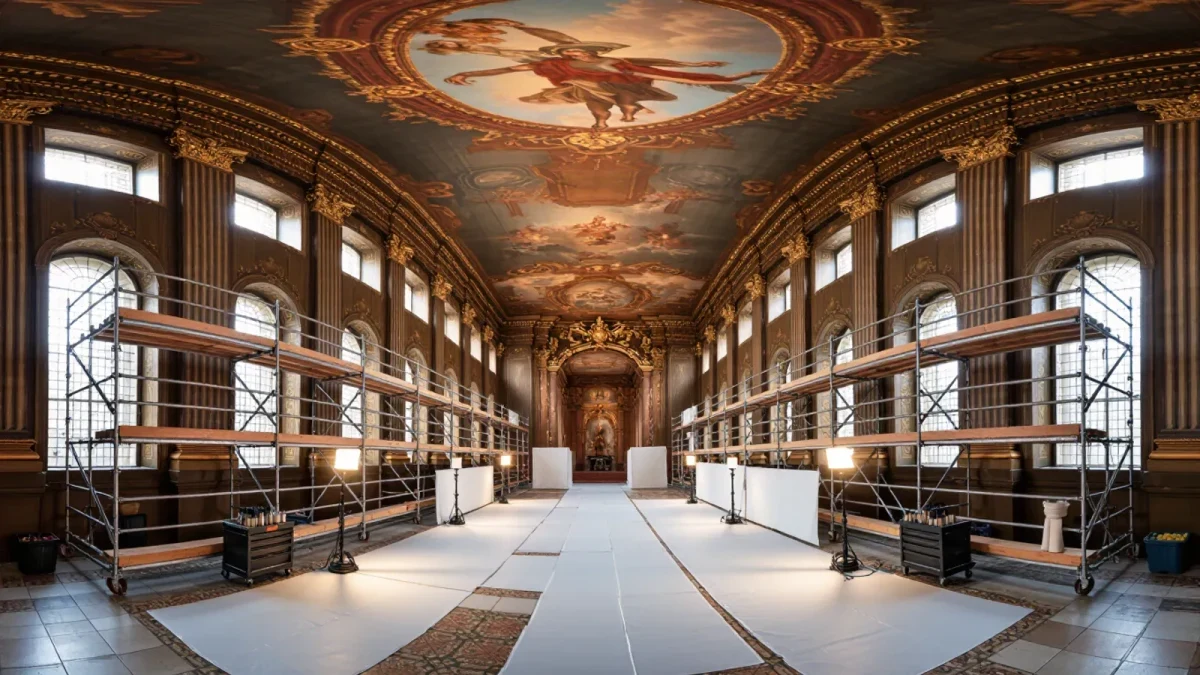
Luxury brands fund art restoration because heritage is their raw material. A maison whose identity rests on craftsmanship has an obvious stake in the survival of the finest craftsmanship on public display, and sponsorship of restoration offers something advertising cannot: a durable, named association with a cathedral ceiling or a palace wing that millions visit each year. The transactions are conventional cultural patronage — a corporate gift funds a defined conservation project, and the institution credits the donor — but for luxury houses the return is unusually direct, since the restored work testifies to exactly the values the brand sells.
What does a restoration sponsorship look like in practice?
A defined project, a named gift and permanent credit. The pattern set over decades in France and Italy runs: a public owner — the state, a city, the Church — lists a monument needing conservation; a house or its foundation signs a convention funding the work; restorers execute over years; and a plaque, catalog and press acknowledgment record the sponsor. The sums are modest by marketing standards — restoration projects commonly run from hundreds of thousands to a few million euros for single monuments, per figures published by heritage agencies and reported by Reuters — while the association lasts as long as the stone does.
Why France and Italy dominate the map?
Supply of monuments and proximity of maisons. France's state heritage portfolio vastly exceeds its conservation budget, a gap governments have invited private donors to close, most visibly through matching-donation campaigns for Notre-Dame after the 2019 fire, which raised roughly 840 million euros in pledged donations from corporations and individuals, per the public bodies that administered the funds. Italy extended generous tax credits for patronage of its cultural patrimony, which explains the density of fashion-house restorations in Rome, Venice and Florence. The houses are headquartered within driving distance of the works they fund.
- Notre-Dame de Paris reconstruction drew roughly 840 million euros in donations after the 2019 fire, per administering public bodies.
- Italy's art bonus tax credits reward corporate and individual patronage of public heritage.
- French maisons have restored chateaux, gardens, fountains and museum wings under named conventions.
- Foundation structures let houses plan patronage beyond any single campaign.
What do the brands get out of it?
A civic identity and content in depth. Restoration sponsorship positions the maison as an institution rather than a commerce — the patron role that pre-modern luxury houses explicitly modeled themselves on. It also generates material: documentaries, exhibitions, bookazines and product tie-ins built around the restored monument, from stained-glass palettes to marble veining, which the houses treat as design research as much as communication. And the association compounds quietly: a visitor who learned the name of a maison from a plaque at a fountain met the brand in the least commercial frame imaginable.
What does the public get — and give up?
Conservation it might otherwise wait decades for, in exchange for acknowledgment rather than control. Sponsorship conventions for public monuments do not transfer ownership or editorial rights over the work; the heritage authority specifies treatment standards and retains custody, while the donor receives credit. Critics of corporate cultural funding argue that private gifts let governments shrink public culture budgets and steer attention toward photogenic monuments over unglamorous maintenance. The counterargument, made by heritage agencies facing backlogs, is that the alternative is not more public money — it is decay.
How do houses choose what to restore?
Nearness of identity first. Jewelers fund gem and decorative-arts collections; leather-goods maisons attach to craftsmanship workshops and artisan schools; couture houses to textiles, palaces and the decorative interiors their collections quote. Geography matters nearly as much — a house restores where its history lives, which is why so many projects cluster in brand hometowns. Institutions also approach houses directly when a project's subject matches a donor's story, per heritage officials describing matchmaking between conservation needs and corporate identities.
Is this philanthropy or marketing?
Tax records say both, and the houses do not hide it. Patronage is budgeted alongside cultural sponsorships and accounted for under the same rules as other corporate giving, with tax treatment for donations in France and Italy reducing the net cost. What separates it from campaign spending is time horizon and reversibility: a sponsorship cannot be cancelled mid-restoration without reputational damage, and its benefits accrue over decades. Executives describing cultural patronage in interviews with Reuters and Bloomberg consistently frame it as brand equity of the slowest- maturing kind — closer to maintaining an archive than buying an advertisement.
Could the model scale beyond Europe?
It travels with difficulty. The European model depends on state-owned heritage, established legal conventions for private gifts and tax incentives — machinery that varies widely elsewhere. Where houses operate globally — in Japan, the Middle East, the United States — they more often fund museums, exhibitions and conservation education than monument restoration, adapting patronage to local structures. The monument model's power remains its European context: the ability to attach a house's name to works that were old before the house existed, and to keep the association in public view without buying a single page of advertising.What happens when the work is finished?
The handover is the marketing. Completed restorations reopen with ceremonies that put heritage officials and maison executives on the same podium, and the project enters the house’s permanent storytelling: anniversary campaigns, foundation reports, exhibition rooms and guided visits that mention the sponsor by name indefinitely. Institutions keep the credit on site, which means a single gift keeps producing impressions for the life of the monument — an annuity no media placement offers. Houses that have restored several works over decades accumulate a patronage record that functions, in effect, as an unaudited second heritage alongside the brand’s own archive — one measured not in sales but in the number of public works a maison’s name is now attached to, quietly, on a plaque most visitors read without ever buying anything. That is precisely the audience the patronage was designed for.
"