Festival accreditation works as a rationing system. Screenings, venues and seats at any festival are finite, so the event divides the people who need access into categories — press, industry, market, film delegations, institutional guests — and issues badges whose color and level determine which queues, rooms and screenings the holder may enter. Per accreditation regulations published by the major festivals, each category has its own application window, eligibility criteria and quota, and the badges themselves are numbered against those caps. Accreditation is not a ticket; it is a rank in a priority order.
What are the main accreditation categories?
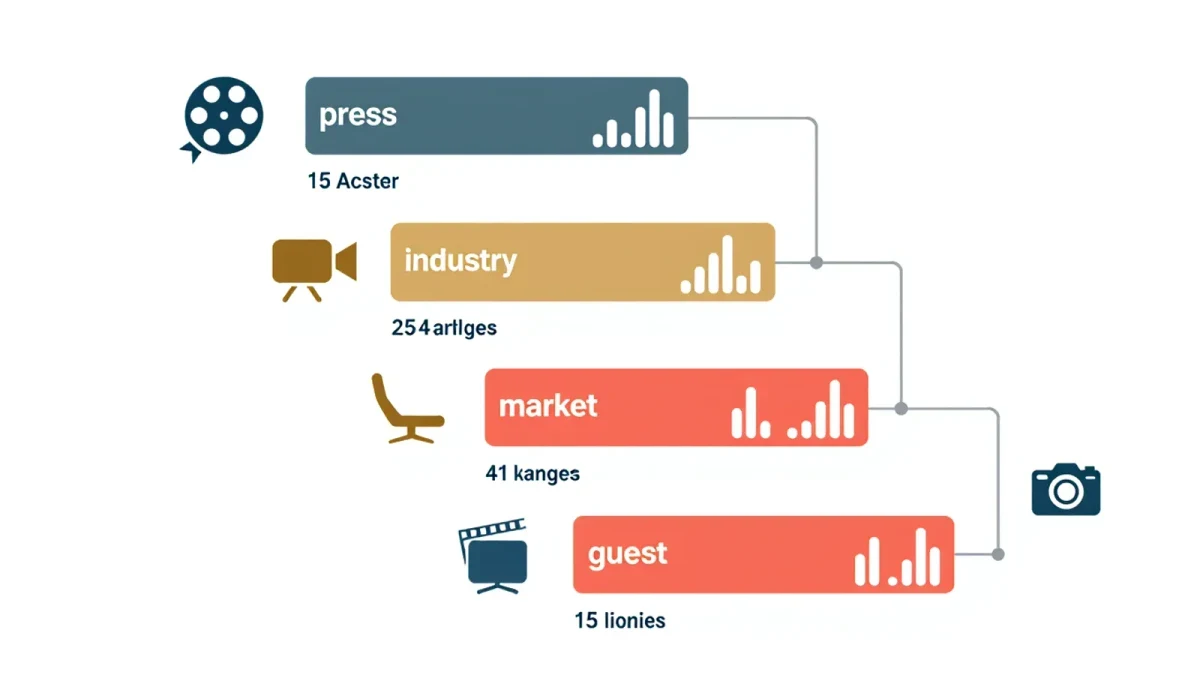
Four broad families cover most badge holders. Press accreditation spans print, online, photo, radio and broadcast, with photo and broadcast the most tightly capped because positions are physical. Industry accreditation covers producers, distributors, sales agents, festival programmers and vendors. Market accreditation attaches to a market badge at festivals that run one, carrying business-center and screening-database access. Guest accreditation covers invited delegations and institutional guests, allocated through the festival's programming and hospitality departments. Per festival access rules, some categories are mutually exclusive — a badge holder generally cannot hold press and industry access simultaneously.
How does a journalist get accredited?
By applying through the festival's press portal before a published deadline, with evidence of assignment or outlet. Editors' letters confirming coverage plans, publication records from previous editions and, for photo accreditation, a portfolio are standard requirements, per festival press regulations. Outlets receive allocations proportional to their reach and their history with the festival, and freelancers apply attached to a commissioning outlet. Late applications are handled case by case, usually refused when quotas have filled.
- Categories — press, industry, market, guest — each carry distinct quotas.
- Photo and broadcast positions are the scarcest badges.
- Outlet allocations scale with reach and prior coverage history.
- Badge level, not ticket purchase, governs entry to demand screenings.
Why do quotas exist at all?
Because capacity is the constraint the public never sees. A premiere auditorium holds a fixed number of seats, and the festival must satisfy, in order, the film's delegation, its guests, accredited press of the appropriate tier and the paying public. When anticipated demand exceeds capacity, festivals operate priority queues by badge level and add overflow or repeat screenings, per their ticketing and access notices. Quotas also protect the event's character: without press caps, a festival's screening rooms would fill with badge holders who do not write, and coverage would fall.
What does an industry badge actually buy?
Access scaled to price and seniority. Industry accreditations are typically paid, with fees rising for late registration, and the badge unlocks the festival's business services — industry screenings, networking events, the festival's online screening platform for a defined window after the event. Per market-participant documentation at festivals with attached markets, higher tiers add lounge access, priority screening booking and meeting-facility reservations. What no badge guarantees is a seat at a hot premiere; industry holders enter those ballots or queues like everyone below the guest tier.
How do film delegations get their badges?
Through the invitation. When a film is selected, the festival grants the production an allocation of guest accreditations tied to the film's section and screening slot — cast, director, producers and a defined number of guests — with additional badges purchasable. Per festival guest regulations, delegations confirm names and travel through the guest office, which also arranges airport transfers and hotel blocks for competition talent. This is the accreditation tier with the highest entry priority, which is why red carpets fill regardless of press demand.
How has accreditation changed in the streaming-platform era?
Demand has broadened while capacity has not. Online outlets, influencers and podcast crews now apply in numbers the category system was not designed for, and festivals have responded with new subcategories and stricter evidence of sustained editorial output, per updated press regulations. The other shift is hybrid access: several festivals extended online screening-platform windows to accredited press and industry after the pandemic-era editions proved the format, making the badge partly a digital entitlement as well as a physical pass.
What happens if you abuse a badge?
Confiscation, and often a ban. Festival regulations treat badge lending, resale and coverage outside the badge's category as violations, and enforcement at entry points is routine. The system works because the ration is credible: a festival that tolerated badge sharing would find its press rooms filled by non-press, and the outlets that actually cover the event would lose the access that makes accreditation worth applying for twelve months in advance.
Is accreditation worth it for a small outlet?
Usually, if the coverage plan is real. A badge removes ticket cost and opens press screenings, talent availabilities and the festival's media workrooms — resources that make a two-person outlet productive on site. The honest calculus involves output commitments: festivals track whether accredited outlets publish, and renewal depends on it. Accreditation is a compact — access in exchange for coverage — and both sides keep score.
How are photo positions and red carpet slots allocated?
Separately from the badge itself. Photo accreditation grants entry to the festival, but positions on the step-and-repeat are assigned by the press office in ranked slots based on outlet seniority, with a defined number of positions per premiere. Per photo regulations issued by major festivals, agencies receive the largest allocations because they syndicate images to many publications, and broadcasters negotiate camera plots weeks in advance through their own accreditation desks. A photographer may hold a valid badge and still skip a premiere if no position was assigned — the two rationing layers are independent.
What does the badge not include?
Lodging, transport and most tickets. Accreditation covers access, not hospitality: press and industry badge holders book their own hotels, and at many festivals they still purchase or ballot for public seats when their badge tier does not grant entry to a given screening. Per festival FAQ guidance, the exceptions are delegation guests and jury members, whose accommodation the festival arranges. First-time applicants are often surprised that the badge is the beginning of the logistics, not the end.