Prestige films premiere in the fall because the Academy's eligibility deadline forces them to. Under Academy rules, a film must complete a qualifying theatrical run — in Los Angeles County, of at least seven consecutive days — within the calendar year to compete in that year's Oscars. That single rule, plus the fact that most voters have long memories for what they saw recently, compresses the serious awards season into roughly September through December and dictates release strategy for months on either side.
What is an eligibility window, exactly?
For the Academy Awards, it is a calendar-year rule: a qualifying seven-day theatrical engagement in Los Angeles County within the award year. Other bodies layer their own deadlines — BAFTA, the guilds and the Golden Globes each have eligibility cut-offs that broadly track the calendar year. A distributor planning an awards film works backward from December 31, then forward from the assumption that voters recall films released late in the year more vividly.
Why is fall so crowded with prestige releases?
Recency bias, operationalized. Campaign consultants and trade reporting have long noted that films released early in the year struggle to sustain voter attention through the months-long voting cycle — though exceptions exist, and the Academy's expanded best-picture field has occasionally carried spring releases to nomination. Fall also aligns with the festival corridor: Venice, Telluride, Toronto and New York run August through October, and a festival launch there generates the reviews and momentum a campaign needs, precisely when voters begin paying attention.
How do festivals anchor the calendar?
The August-to-October festival corridor has become the true start of awards season. Telluride and Venice launch titles over a single Labor Day weekend corridor; Toronto follows with audience prizes that have correlated with best-picture success; New York closes the launch window in early October. Distributors book release dates months in advance to sit four to twelve weeks after a festival premiere, long enough to convert reviews into a campaign, short enough to stay in the conversation.
What is a qualifying run and why does it matter?
A qualifying run is the minimum theatrical engagement that makes a film eligible. Streamers without broad theatrical businesses have historically booked short, limited engagements in Los Angeles — sometimes a single theater for one week — to qualify for the Academy Awards while their films premiere, functionally, on a platform. The practice drew exhibitor criticism and rule scrutiny, and the Academy tightened its eligibility requirements for the 2024 ceremony and after, adding expanded-theatrical-run conditions that a streaming title must meet to qualify — rules changes the Academy announced publicly.
Why do some awards films open in December?
Platform release economics. A limited New York and Los Angeles opening in late November or December establishes eligibility and reviews, then the film expands wide in January after nominations, when Academy attention converts into ticket sales. Nominations, not opening weekend, are the commercial event for an awards title, and the calendar is engineered so the widest release follows the announcement of the nods.
What happens to films that miss the window?
They are held. A finished film that cannot secure a fall slot — because the corridor is crowded or a campaign cannot be funded — may sit for months to premiere at a festival the following year, aiming at the next cycle. Distributors describe deliberate year-end stockpiling of prestige titles for exactly this reason; the alternative, a January or February dump month, carries a stigma of low confidence that is hard to buy back with advertising.
How do dates interact with rival releases?
Claiming a date is competitive chess. Distributors announce prestige release dates early to plant flags on key weekends, then shuffle as rivals crowd in — trade coverage of schedule jockeying between rival awards contenders is a fixture of every fall season. Variables include audience overlap with other adult dramas, IMAX or premium-large-format screen availability, and the length of the runway between release and nomination voting.
Do the same windows apply internationally?
Partially. BAFTA's calendar tracks the Academy's closely, and the European Film Awards run their own autumn cycle. But non-English-language films face an additional piece of arithmetic: each country submits one film for the Academy's international feature category, with submission deadlines in the fall, so national release dates are engineered around domestic submission campaigns that may matter more to a film's fate than its commercial run.
What is the practical timeline for an awards release?
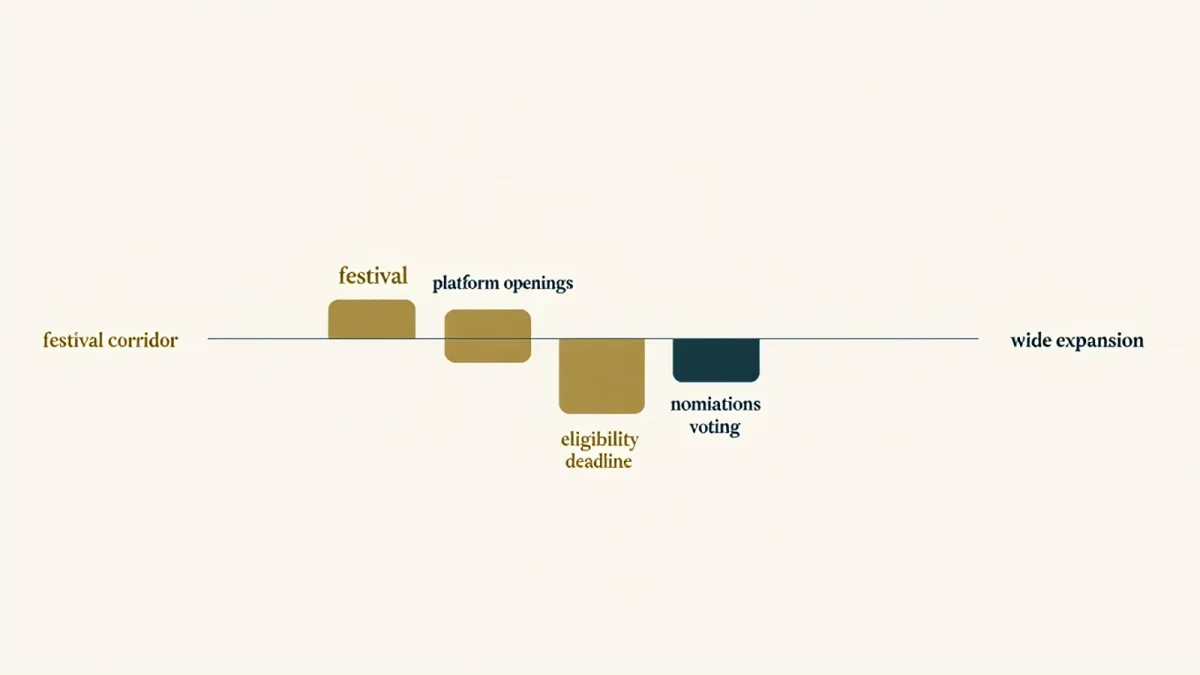
- Spring-summer: distributors tentatively date prestige titles; festival submissions go out.
- August-October: festival corridor launches contenders; release dates lock.
- October-December: platform openings, qualification runs, year-end eligibility deadline.
- December-January: nominations voting; shortlists and guild announcements.
- January-February: wide expansions after nominations; final voting; ceremony.
Why does this calendar survive year after year?
Because every participant's incentives point the same direction. Voters see contenders when attention is highest. Festivals get the best films. Distributors get campaigns that convert into ticket sales. The Academy gets an event whose finalists arrive pre-validated by months of coverage. The result is an industry calendar that looks organic but is, in fact, a machine built backward from a December 31 deadline.
How do documentary and international films navigate the calendar?
Differently, and on harder schedules. Documentaries need awards heat to justify theatrical engagement, so the strongest docs premiere at Sundance in January, hold speciality releases through the summer, or launch in the fall corridor for a year-end qualifying run. International features face the submission arithmetic: each country picks one film for the Academy's international category by an autumn deadline, so a national release may be timed to impress a domestic selection committee rather than to maximize local admissions. Both paths show the same rule from different angles — the award, not the audience, sets the date.
What role do screeners and screen counts play in dating?
Availability shapes perception. A four-wall Los Angeles qualifying run exists for voters, not audiences, while a 3,000-screen release is an audience event that also satisfies eligibility. Marketers sequence these deliberately: enough screens to generate grosses that read as success, few enough that expansion after nominations still feels like growth. Dating strategists describe the release pattern itself as a narrative device — one that trade coverage reads weekly as evidence of a campaign's health.