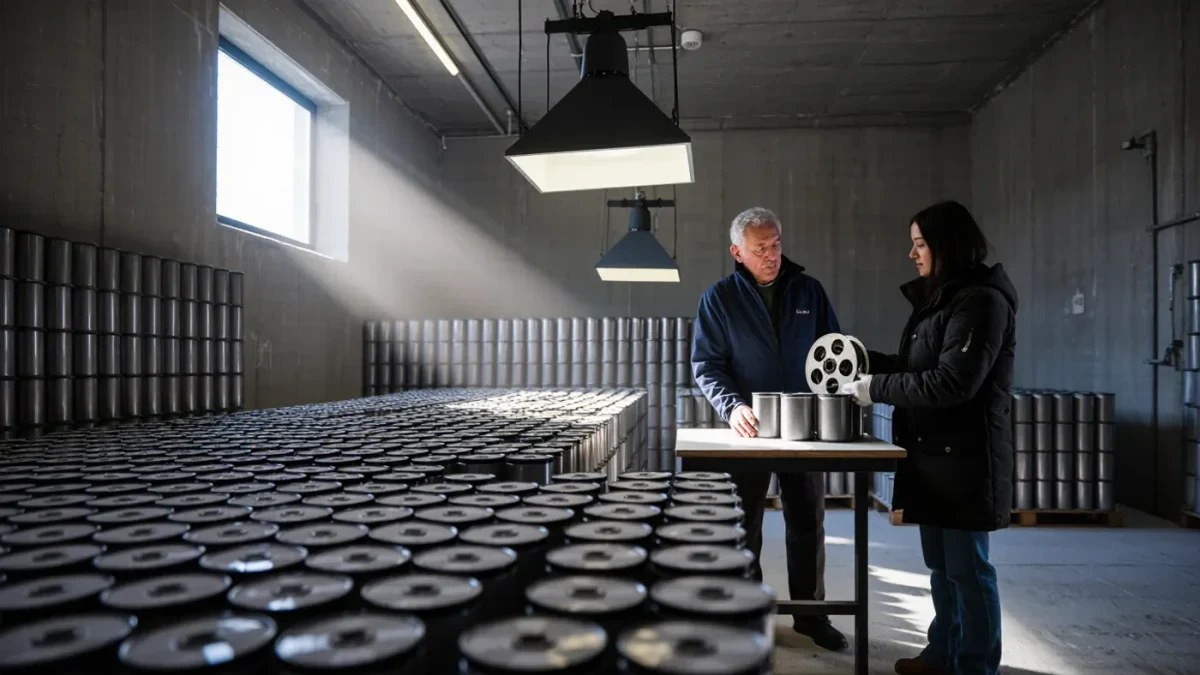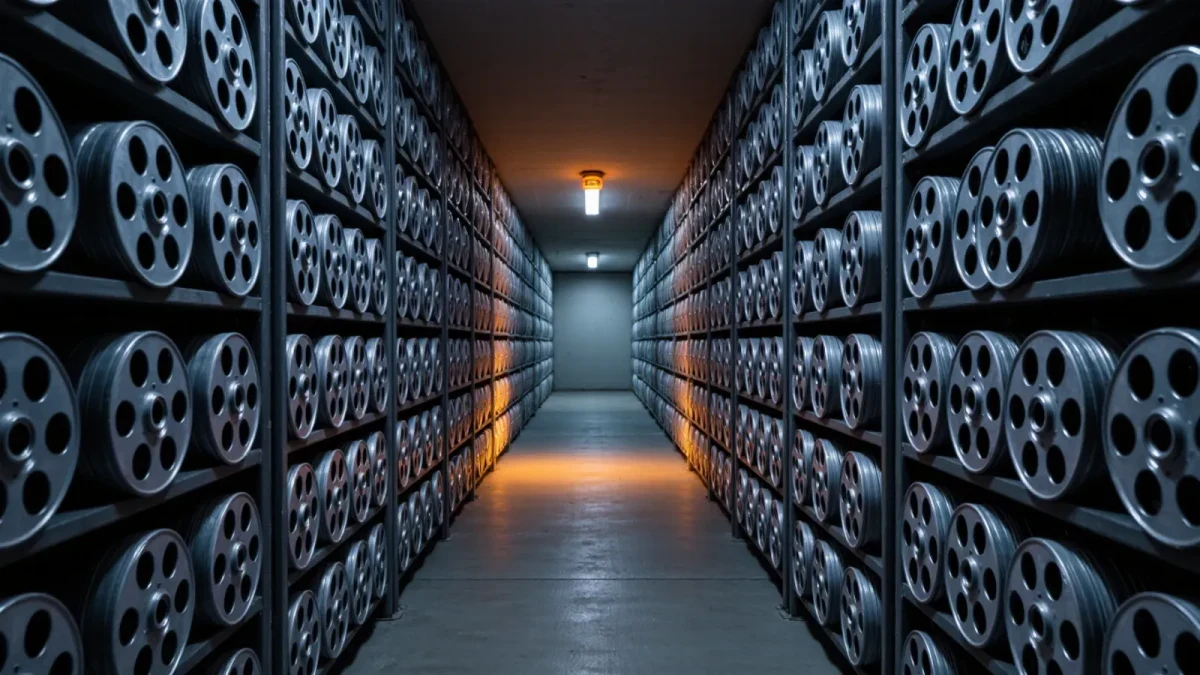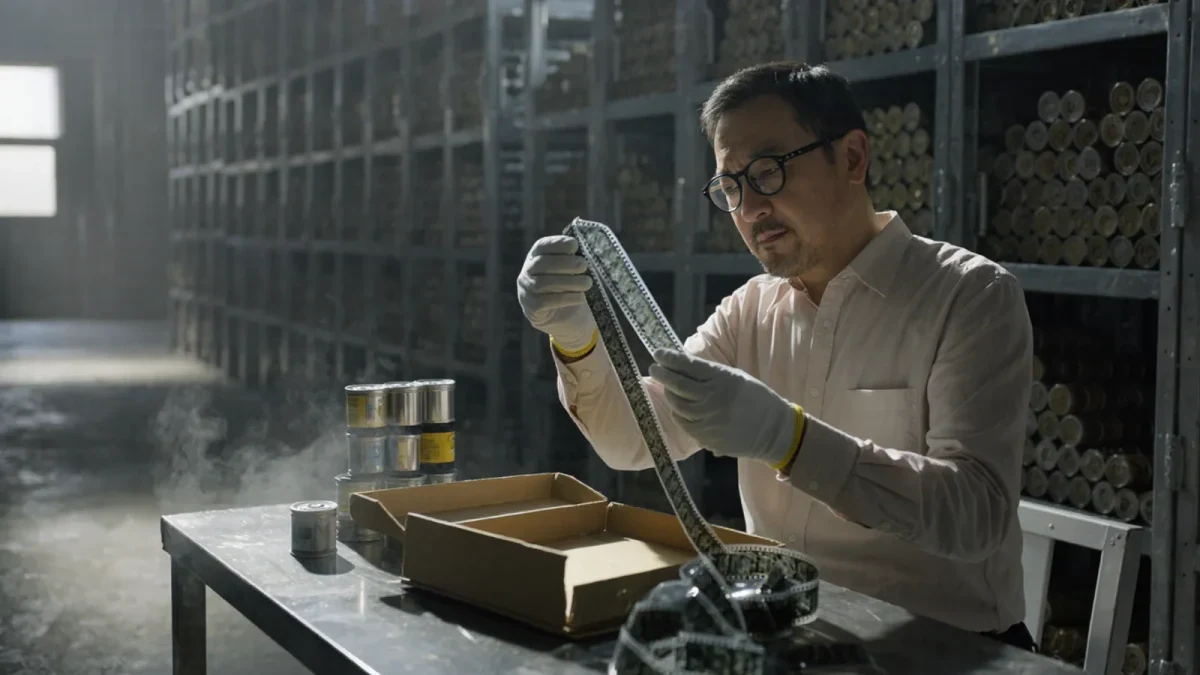
Film archives preserve cinema history by storing original negatives and prints in climate-controlled vaults, inspecting them for decay and restoring damaged elements in specialized laboratories. The scale of the task is stark: the Library of Congress has periodically estimated that a majority of American silent-era films are already lost, and roughly half of the films made before 1950 survive in no complete domestic copy. Preservation is a continuing institutional effort, not a completed project.
What actually threatens old film stock?
Two things above all: chemistry and neglect. Cellulose nitrate stock, used through the early 1950s, is chemically unstable and flammable — it can ignite spontaneously as it decomposes, and archives store it in specialized vaults under fire codes built for the hazard. Its successor, cellulose acetate, suffers "vinegar syndrome," a autocatalytic decay in which the base shrinks, buckles and releases acetic acid. Color dyes fade. Cold and dry storage slows all of it dramatically, which is why vaults run at near-freezing temperatures with low relative humidity.
Who are the main institutions doing this work?
A mix of public and nonprofit. The Library of Congress holds one of the largest film collections in the world through its Packard Campus for Audio-Visual Conservation, funded in significant part by a private gift from the Packard Humanities Institute. In Europe, national archives like the Cinémathèque française and the BFI National Archive perform equivalent roles. In the private sphere, studio archives — Warner Bros., Universal, Disney and others — maintain their own libraries, and the UCLA Film & Television Archive preserves both studio donations and independent work.
What does the Film Foundation do?
The Film Foundation, the nonprofit founded by Martin Scorsese and fellow filmmakers in 1990, has helped fund the restoration and preservation of more than 1,000 films, working with archives and studios worldwide, according to figures the organization publishes. It channels donor money toward specific restoration projects, trains preservation professionals through affiliated programs, and advocates for film culture — its stated rationale being that a civilization that loses its moving-image record loses a form of memory.
What is the difference between preservation and restoration?
Preservation is stabilization: creating archival storage conditions and copying deteriorating elements onto stable film stock before they are lost. Restoration is reconstruction: comparing surviving elements — original negative, release prints, trims, sound discs — and assembling the version closest to the film as originally released. Restoration can take years on a single title, combining photochemical duplication, digital scanning, frame-by-frame damage repair and, where the negative is gone, sourcing prints from archives on multiple continents.
How does a restoration actually happen, step by step?
- Survey: archivists locate and inspect all surviving elements, grading their condition and completeness.
- Element selection: the best photographic source — often the original camera negative — is chosen for duplication.
- Photochemical or digital duplication: the element is copied or scanned at 4K resolution or higher for fine-grain work.
- Repair: technicians fix tears, shrinkage, mold, dye fading and sound damage, sometimes frame by frame.
- Photochemical output: the restored film is output back onto new film stock as well as digital files, because archives keep film as the long-term medium — properly stored film has outlasted every digital format so far.
- Access: the restored title screens at festivals, in retrospectives and on home video, which is where the funding logic closes.
Why do archives still keep film rather than just digitizing?
Because digital formats obsolesce. Film, stored cold, has a demonstrated lifespan of a century or more and needs only light and a lens to read. Digital files require active management — migration, format verification, working hardware — and archives have watched professional video and digital formats become unreadable within decades. The professional consensus, reflected in Library of Congress preservation practice, treats digital as an access and restoration medium and film as the archival medium of record.
How much does restoration cost?
Institutional practitioners describe wide ranges: a straightforward reprint of a stable element can cost tens of thousands of dollars, while a full 4K restoration of a damaged feature — negative lost, fading severe, sound elements scattered — can run into the high six figures. Color films of the 1970s and 1980s shot on unstable stock are now among the most urgent cases, a priority the Film Foundation and studio archives have both flagged.
Where do audiences see the results?
Restorations premiere at festivals — Cannes Classics is a dedicated program — and circulate through retrospectives, Blu-ray editions and streaming licenses. That visibility is strategic: restored classics earn the licensing revenue and donor attention that fund the next round of preservation, keeping the archives' work economically legible to the industry whose history they maintain.
How do archives decide what to save first?
Through condition surveys and risk ranking. Archivists inspect collections on rotating schedules, grading each element's decay stage, and the worst-condition unique items move to the head of the duplication queue. Uniqueness matters most: a title held in ten archives is a lower priority than the sole surviving print of a lost film. National preservation boards and donor funders both weight rarity and historical significance in grant decisions, which concentrates resources on the films no one else will save.
Can decaying film be rescued after damage has started?
Often, yes, within limits. Nitrate in early decay can still be duplicated; vinegar syndrome can be slowed with cold storage and, in advanced cases, treated through careful rehumidification before scanning. Shrunken film requires specialized printers that adjust frame-by-frame. The hard boundary is total loss — emulsion that has fused or decomposed beyond the gelatin cannot be recovered, which is why the field's consistent message is that storage conditions today determine what remains possible decades from now.
What can audiences do to support preservation?
More than they might assume. Archive memberships and donor programs fund cold storage and lab work; attending restorations at repertory houses and festivals gives restored titles the box office signals that justify future projects; and home-viewing purchases of restored editions route royalties back to rightsholders who decide what gets restored next. Archivists also point to a quieter contribution: identifying and donating home movies and local footage, since families often hold the only surviving record of places and communities that institutions never collected.