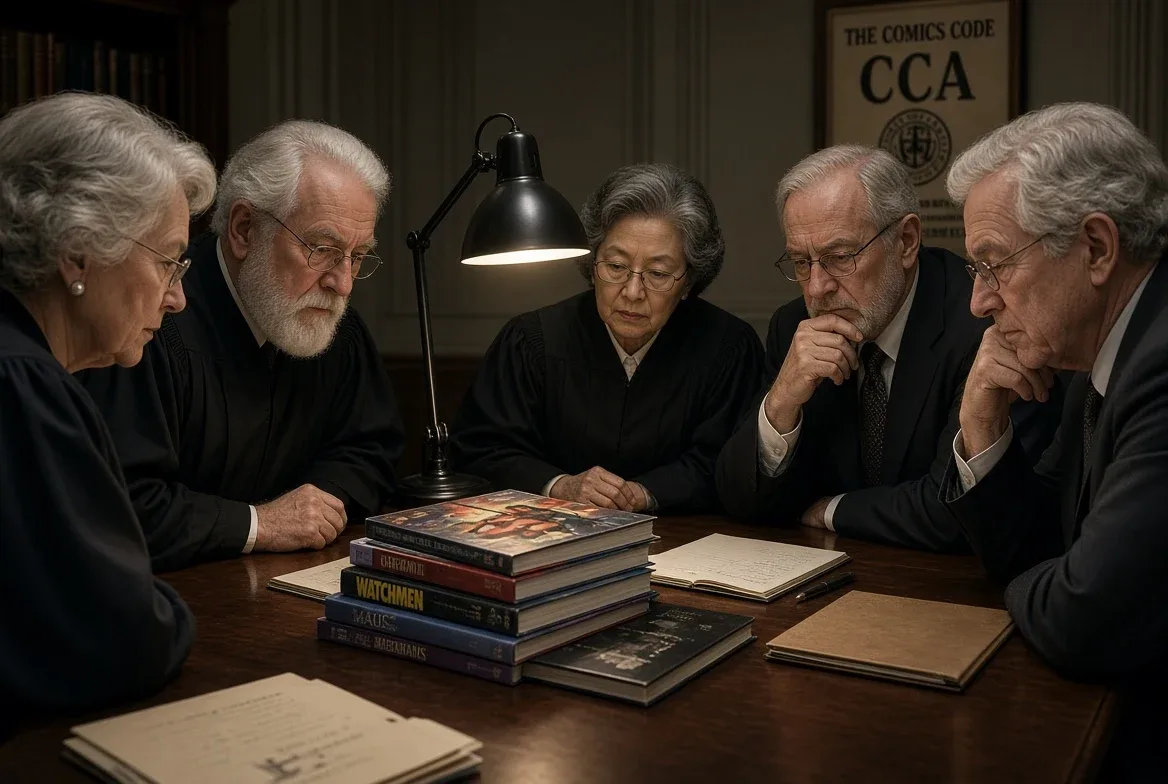
The Will Eisner Comic Industry Awards choose their nominees through a two-stage process: a rotating panel of five or six judges meets each spring in San Diego to review the prior year's eligible work, then a wider industry electorate votes on the resulting ballot, according to Comic-Con International's official rules for the awards. The panel's composition changes annually, and no single publisher, retailer, or critic sits on it twice by design.
Who actually sits on the judging panel?
The panel is built from six people representing different corners of the comics business, typically drawing one each from categories such as a working creator, a critic or reviewer, a graphic novel librarian, a comic shop retailer, an academic scholar, and a member of Comic-Con International's own organizing committee, per the organization's FAQ. That mix is a target, not a fixed roster — the FAQ notes the exact composition shifts from year to year depending on who is available and willing to serve.
A special awards committee inside Comic-Con International selects the judges, and the organization says it stays "open to input from a variety of sources" when filling seats, rather than running an open application process. Comic-Con's own list of past panels shows the group has run as small as five members, as in 2025, when the panel was Robert V. Conte, Kacy Helwick, Meg Lemke, Eitan Manhoff, and Rocco Versaci, and as large as six, as in 2024's panel of Ryan Claytor, N. C. Christopher Couch, Andréa Gilroy, Joseph Illidge, Mathias Lewis, and Jillian Rudes.
How does a comic get in front of the judges in the first place?
Eligibility runs on a calendar-year window: a work must have been distributed in the United States between January 1 and December 31 of the previous year, and material published online has to clear the same window, according to the official rules. Publishers are capped at five submissions per category, which forces houses with crowded release slates to prioritize rather than flood every category with contenders.
Self-published creators are not shut out of that math. The rules specifically allow a creator working outside a traditional publisher to submit their own eligible work for consideration, putting a webcomic-turned-collection or a self-financed graphic novel on the same submission form as a major imprint's flagship release.
What happens once the panel convenes?
The judges meet in person in San Diego each spring to work through the eligible pool and settle on nominees, using what Comic-Con International describes as a "blue-ribbon panel" approach — the group's collective judgment, rather than a public vote or a scoring rubric, decides which titles make the ballot. The organization does not publish a category-by-category tally of how many submissions the panel reviews in a given year, and the exact deliberation format beyond the spring meeting is not detailed in the public rules.
The categories themselves number more than thirty in most years, covering everything from best writer and best penciller/inker to best archival collection and best comics-related periodical, though Comic-Con International notes the exact count moves year to year as categories are added, combined, or dropped to keep pace with how the industry publishes work.
Who votes once the nominees are set?
Nominations are typically announced in May, and the ballot then opens to a much larger group than the five or six judges who built it: comic creators, publishers, editors, historians, educators, librarians, and owners or managers of comic specialty retail stores are all eligible to cast a vote through an online ballot, per Comic-Con International. That two-tier structure — a small curatorial panel setting the field, a broad industry electorate picking the winner — is what separates the Eisners from awards decided by a single juried vote.
Winners are announced at a ceremony held on a Friday night during Comic-Con International in San Diego, at the Indigo Ballroom of the Hilton San Diego Bayfront, the venue the event settled into after moves from the Hyatt and from Ballroom 20 at the San Diego Convention Center.
Where did this system come from?
The Eisners trace back to 1988, when they were established to honor comics work published in 1987. They picked up where the Jack Kirby Awards left off: Fantagraphics Books had created that earlier prize in 1984 and first handed it out in 1985, and when administrator Dave Olbrich left Fantagraphics in 1987, the Kirby Awards ended with him. Olbrich founded the new awards as a nonprofit and named them for Will Eisner, the cartoonist behind "The Spirit" and an early architect of the graphic novel form.
Olbrich ran the awards for two years, but no ceremony was held in 1990. Comic-Con International took over administration starting with the 1991 show, and Jackie Estrada became the awards' administrator that year — a role she still holds today, according to the organization's published history. The ceremony added celebrity presenters and, starting in 1995, a keynote speaker, as it grew from a daytime program slot into Comic-Con's marquee Friday-night event.
| Year | Milestone |
|---|---|
| 1984-85 | Fantagraphics Books creates and first awards the Jack Kirby Awards |
| 1987 | Dave Olbrich leaves Fantagraphics; the Kirby Awards end |
| 1988 | The Will Eisner Comic Industry Awards launch, honoring 1987 work |
| 1990 | No ceremony is held |
| 1991 | Comic-Con International takes over administration; Jackie Estrada becomes administrator |
| 1995 | The ceremony adds a keynote speaker for the first time |
That history matters for how the panel operates today: because Comic-Con International, not a publisher or a trade group, has run the selection process for more than three decades, the awards' credibility rests on the judges' independence from the companies whose books they're reviewing — the same tension that shapes juried prizes across publishing and film.
Frequently asked questions
How many Eisner Award categories are there in a typical year?
More than thirty, covering writing, art, editing, design, and format-specific honors like archival collections, though Comic-Con International adjusts the exact count annually as categories are added, merged, or retired to match how the industry is publishing.
Can a self-published creator submit their own comic?
Yes. The official rules allow creators working outside a traditional publisher to submit their own eligible work for judging, alongside the up-to-five submissions per category that traditional publishers are allotted.
Who is eligible to vote once nominees are announced?
A broad industry electorate: comic creators, publishers, editors, historians, educators, librarians, and comic specialty retail store owners or managers can all vote on the published ballot, which is separate from the smaller judging panel that set the nominees.
Who currently administers the Eisner Awards?
Comic-Con International has administered the awards since taking over at the 1991 show, with Jackie Estrada serving as administrator continuously since that year, according to the organization's published history.
For a related collecting perspective, read How Does CGC Grading Work? A Collector's Guide to the Comic Grading Scale.
For more context, read How Streaming Popularity Charts Actually Work, Explained.
For more context, read At the Oscars, the Red Carpet Stopped Being Red.
For more context, read What streaming viewership numbers actually measure.